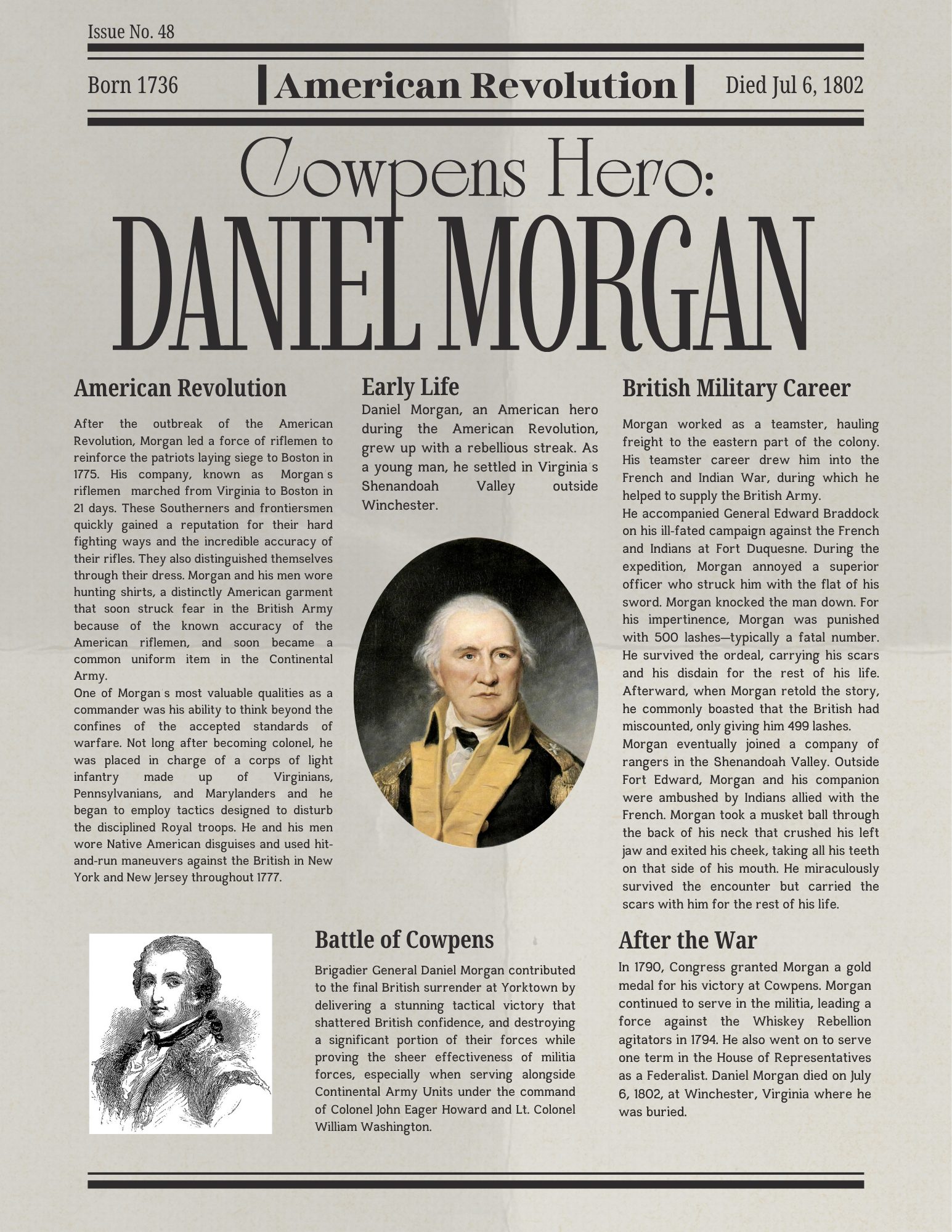
Daniel Morgan

Early Life

Daniel Morgan, an American hero during the American Revolution, grew up with a rebellious streak. As a young man, he settled in Virginia’s Shenandoah Valley outside Winchester.

Career with British Army

Morgan worked as a teamster, hauling freight to the eastern part of the colony. His teamster career drew him into the French and Indian War, during which he helped to supply the British Army.

He accompanied General Edward Braddock on his ill-fated campaign against the French and Indians at Fort Duquesne. During the expedition, Morgan annoyed a superior officer who struck him with the flat of his sword. Morgan knocked the man down. For his impertinence, Morgan was punished with 500 lashes—typically fatal number. He survived the ordeal, carrying his scars and his disdain for the rest of his life. Afterward, when Morgan retold the story, he commonly boasted that the British had miscounted, only giving him 499.

Morgan eventually joined a company of rangers in the Shenandoah Valley. Outside Fort Edward, Morgan and his companion were ambushed by Indians allied with the French. Morgan took a musket ball through the back of his neck that crushed his left jaw and exited his cheek, taking all his teeth on that side of his mouth. He miraculously survived the encounter but carried the scars with him for the rest of his life.

American Revolutionary War

After the outbreak of the American Revolution, Morgan led a force of riflemen to reinforce the patriots laying siege to Boston in 1775. His company, known as “Morgan’s riflemen” marched from Virginia to Boston in 21 days. These Southerners and frontiersmen quickly gained a reputation for their hard fighting ways and the incredible accuracy of their rifles. They also distinguished themselves through their dress. Morgan and his men wore hunting shirts, a distinctly American garment that soon struck fear in the British Army because of the known accuracy of the American riflemen, and soon became a common uniform item in the Continental Army.

One of Morgan’s most valuable qualities as a commander was his ability to think beyond the confines of the accepted standards of warfare. Not long after becoming colonel, he was placed in charge of a corps of light infantry made up of Virginians, Pennsylvanians, and Marylanders and he began to employ tactics designed to disturb the disciplined Royal troops. He and his men wore Indian disguises and used hit-and-run maneuvers against the British in New York and New Jersey throughout 1777.

Battle of Cowpens

Morgan’s main adversary was British Lieutenant Colonel Banastre Tarleton. Tarleton and Morgan’s forces faced each other at Cowpens in South Carolina on January 17, 1781. Morgan emerged victorious and secured his reputation as a skilled military tactician. Utilizing knowledge of his enemy’s aggressive and impulsive behavior, Morgan lured Tarleton into a trap with a fake retreat. Tarleton charged, only to be surprised when Morgan’s infantry turned to fire and a hidden cavalry force joined the conflict. The victory was complete and was a turning point in the war in the South.

After the War

In 1790, Congress granted Morgan a gold medal for his victory at Cowpens. Morgan continued to serve in the militia, leading a force against the Whiskey Rebellion agitators in 1794. He also went on to serve one term in the House of Representatives as a Federalist. Daniel Morgan died on July 6, 1802, at Winchester, Virginia where he was buried.